Director Alan Abramson Participating in Local Government Event on October 9th

There’s a saying that all politics is local. As we stand at a quarter of the way into this century, how are local governments operating, and, importantly, keeping in sync with their constituents in today’s world of rapid technology, social media and polarization? When contending with critical social issues like affordable housing or economic development, are elected leaders taking the public’s pulse or proceeding, assuming their policy has support? Have recent controversial issues like the “Missing Middle” affordable housing initiative and the Monumental Sports arena failure, laid bare a growing rift between local government and constituents? Is the “Arlington Way” and the “Alexandria Way” of consensus building gone? 

Join Advance Arlington, Agenda Alexandria, George Mason University’s Schar School of Policy and Government and the Office of Community and Local Government Relations for this special event with two distinguished elected officials as they prepare to step away from public office: Arlington County Board Chair Libby Garvey and Alexandria City Mayor Justin Wilson. We welcome their input and perspectives on topics that include:

  • Are the “Alexandria Way” and the “Arlington Way” still effective for constituent input?
  • How has local government changed in the last several decades?
  • Lessons learned on economic development and affordable housing controversies
  • Civility in public engagement given our polarized times
  • How technology is / isn’t being used to engage the public
  • Are we reaching young constituents who make up a growing population?
  • Does one-party control of a local government hamper compromise?
  • Advice for current and future local elected officials

This event will take place on Wednesday, October 9th at 6:30 p.m. in the auditorium at George Mason University’s Arlington campus. Light refreshments will be provided. Participants can also register to attend via Zoom.

Author and journalist Michael Pope will moderate the conversation. Dr. Alan Abramson, professor and the director of the Center on Nonprofits, Philanthropy, and Social Enterprise in the Schar School of Policy and Government at George Mason University, will provide an overview of the major topics and issues to be discussed during the panel. 
Regional Nonprofit Scholars Gather at the Schar School

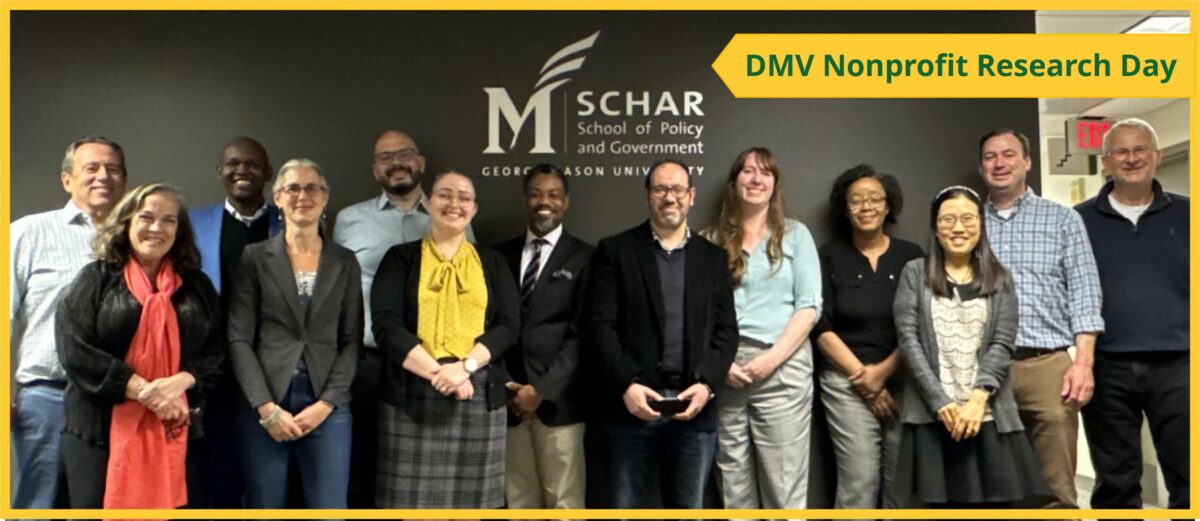
The DMV Nonprofit Research Day, hosted by the Schar School’s MPA program and the Center on Nonprofits, Philanthropy, and Social Enterprise, took place on April 5th at George Mason University’s Mason Square/Arlington campus. The event attracted many nonprofit scholars from the District of Columbia, Maryland, and Virginia (DMV) region, including well-known researchers Khaldoun AbouAssi (American University), Angela Bies (University of Maryland), Luisa Boyarski (Georgetown Unievrsity), Nathan Dietz (University of Maryland), Lewis Faulk (American University), Jasmine Johnson (George Washington University), , John Ronquillo (University of Maryland), Steven Rathgeb Smith (American Political Science Association and Georgetown University), Joannie Tremblay-Boire (University of Maryland), and Mary Tschirhart (George Washington University). Doctoral students from American University, George Mason University, and James Madison University also joined the meeting. The event was hosted by Schar School nonprofit faculty Mirae Kim, Stefan Toepler, and Alan Abramson.

The day began with networking over coffee, followed by a presentation by Mirae Kim and Joannie Tremblay-Boire discussing how changes in a nonprofit’s mission can be adaptive or concerning. The results from a survey administered by the Nonprofit Organization Research Panel, housed at George Mason, ignited an intense discussion among the attendees, providing constructive feedback for the presenters. Nathan Dietz delivered the second morning presentation, focusing on social connectedness and generosity. His talk spurred dialogue on the decline of volunteering in the US and the factors driving greater volunteerism in poorer neighborhoods, among other topics.

Boxed lunches were provided, allowing participants to choose any spot on campus for their meal. However, as Joannie Tremblay-Boire noted, most chose to remain in the meeting room to continue their discussions, emphasizing the value of the “company” over the “location,” and expressing her own enjoyment in engaging with fellow nonprofit researchers.

The afternoon sessions were packed with three presentations, starting with Kathryn Grossman (American University) and Khaldoun AbouAssi, who discussed trust between local government and nonprofit collaborators. Stefan Toepler then explored trends in nonprofit research topics, prompting a debate on whether the growth of nonprofit research in Public Administration journals has shifted the focus of the field. This discussion led to broader considerations of the interdisciplinary nature of nonprofit research and the optimal development path for the nonprofit research field. The event concluded with a presentation by Lewis Faulk on “Nonprofit Advocacy and Lobbying: A Call for Clarification and Action,” co-authored with Mirae Kim and others. The session sparked a lively debate on the evolving role of nonprofits in public policy and the importance of legal knowledge among nonprofit leaders.

In a concluding discussion, meeting participants expressed strong interest in continuing this regional meeting, perhaps convening once a semester at different local universities.

Schar professors attended a White House Roundtable on Nonprofit Workforce and Data

By: Buzz McClain

Schar School professors Alan Abramson and Stefan Toepler attended a White House Roundtable on Nonprofit Workforce and Data last week.

The roundtable, which was organized by White House staff in collaboration with Independent Sector and the Aspen Institute’s Program on Philanthropy and Social Innovation, engaged participants in dialogue about the ongoing challenges facing the nonprofit workforce and the critical role that U.S. government plays in shaping and advancing policy interventions that are crucial to addressing the needs of the nonprofit workforce.

Professor Abramson

The roundtable touched on an important area of focus for the Schar School’s Center on Nonprofits, Philanthropy, and Social Enterprise, directed by Abramson. With support from the Charles Stewart Mott Foundation, the center is engaged in a major project, the George Mason University – Nonprofit Employment Data project, that analyzes federal nonprofit employment data and is developing a website to make this data available to the public and scholars in an easily accessible format. 

The project is also exploring other federal data sources that contain information about nonprofits which can be helpful to policymakers, nonprofit leaders, and scholars seeking to deepen their understanding of nonprofit activities.

For more information about recent Schar activities, check out this post by Buzz McClain.

Schar’s MPA program and Nonprofit Center hosted a screening and discussion of “Uncharitable”

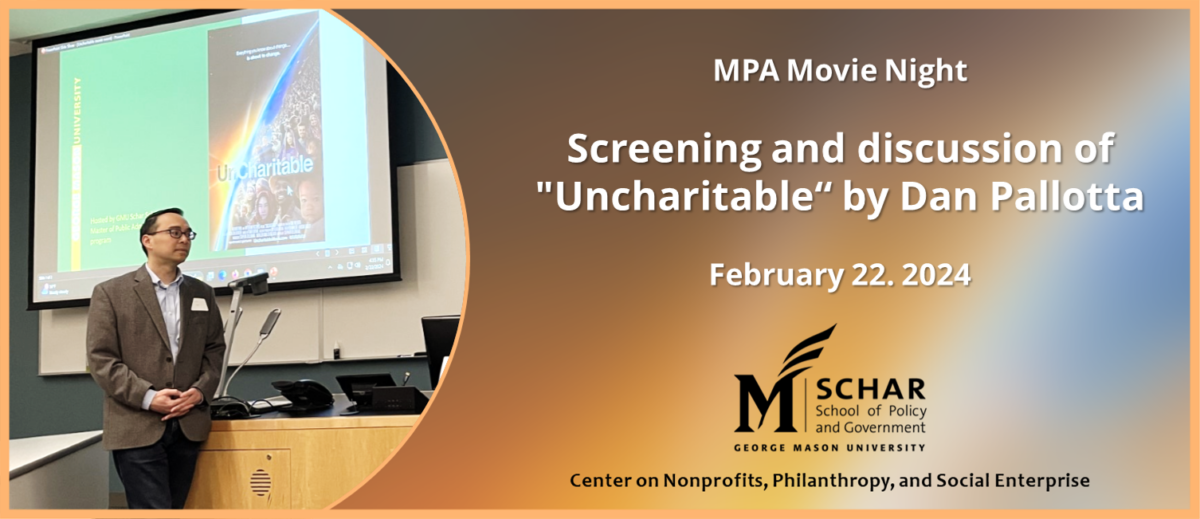
The Schar School’s MPA Movie Night, hosted by the Schar School MPA program along with the Center on Nonprofits, Philanthropy, and Social Enterprise, took place on February 22nd at George Mason University’s Mason Square/Arlington campus. Faculty, students, and community members were invited to watch and discuss “Uncharitable,” a movie featuring Dan Pallotta of Ted Talk fame. The evening began with a screening of the documentary, followed by a stimulating discussion led by adjunct faculty member Cliff Yee, who is also an MPA Advisory Board member, and MPA faculty members Mirae Kim, Stefan Toepler, and Alan Abramson. This discussion explored several themes from the movie, including reframing the idea of “overhead,” questioning nonprofit compensation, and challenging conventional wisdom about philanthropy. Attendees, including MPA students, alumni, and local nonprofit leaders, exchanged perspectives and debated the movie’s implications in a thought-provoking and engaging event.

The documentary sparked a good discussion about norms and unspoken conventions that often steer nonprofit practices. One of the local leaders in attendance was Jorge E. Figueredo, Executive Director of Edu-Futuro, who has over 24 years of experience in the nonprofit sector. Figueredo agreed with many of the movie’s themes and explained, “Nonprofit practices are outdated and need to be rethought. I welcome and encourage spaces, like the one created during this showing, to go deeper into rewriting the rules and changing the paradigms.” Although not all attendees came to the same conclusion regarding the film’s assertions, attendees appreciated the chance to take a step back and assess how nonprofits operate and how their funders and others can better engage with them. The event also encouraged critical thinking among nonprofit stakeholders, highlighting the university’s commitment to providing enriching opportunities for open dialogue and exploration, both for students and the nonprofit community.

“As a nonprofit practitioner, while I felt validated watching the documentary, I have a strong hope that we will be able to spread the word about the untapped potential that exists when nonprofits are given a bit more latitude to fulfill their missions.”
Roopal Mehta Saran
Executive Director, English Empowerment Center
“If you are passionate about a particular cause that is supported by nonprofits, watching “Uncharitable” should provide valuable insights into the realities of how these organizations operate and whether there are more effective ways to make a positive impact.”
Shannon Steene
Executive Director of Carpenter’s Shelter
“I welcome and encourage spaces, like the one created during this showing, to go deeper into rewriting the rules and changing the paradigms. To tackle serious issues and change the world, these organizations must be allowed to acquire the tools and use the methods that are most effective.”
Jorge E. Figueredo
Executive Director, Edu-Futuro

For updates about the center and to learn more about events like this, sign up for the Center’s newsletter here:

* indicates required

2023 Community Partnership Forum convenes regional leaders to discuss workplace culture

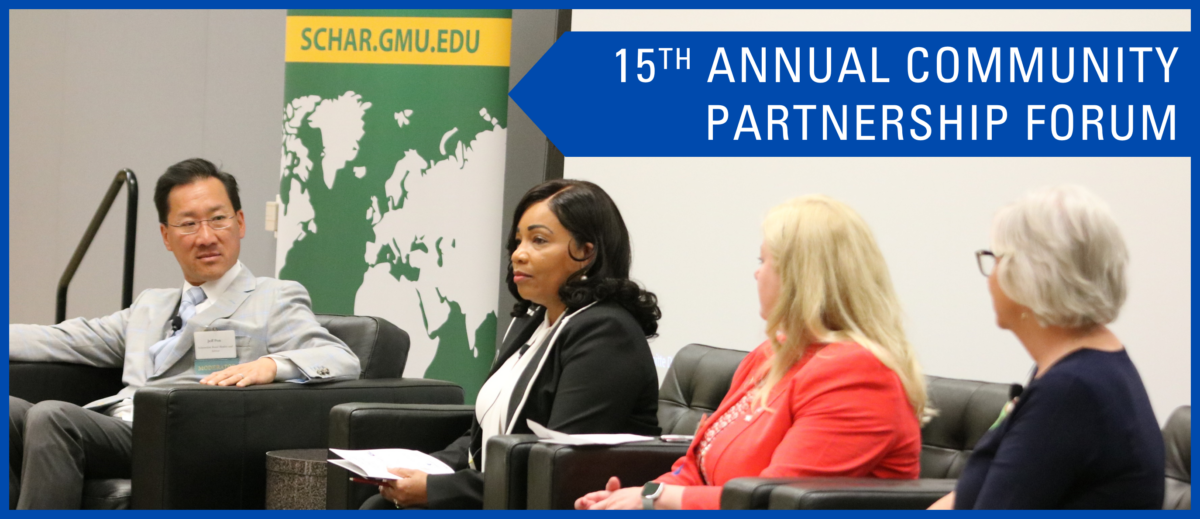
On May 2, the 15th annual Community Partnership Forum brought together government, business, and nonprofit leaders from Northern Virginia and nearby areas to discuss the importance of workplace culture for hiring and maintaining a talented workforce and ensuring high organizational performance. The discussion was kicked off by Mark Schwartz, the County Manager for Arlington County, who described the ways the COVID-19 pandemic changed the nature of work for county employees and continues to present new challenges as the county seeks to find a balance between providing flexibility for its employees to work remotely while also giving them opportunities to feel connected.

Glenn Davidson and Emily Omrod from Deloitte Consulting LCC explained that Arlington County is not alone in seeking to strike this balance. In the first plenary session of the forum, they presented key workforce trends and action steps leaders can take to tackle the new challenges that are arising. Based on workforce surveys and data from across the globe, Davidson and Omrod indicated that workers are feeling exhausted and are resigning and moving locations at high rates. For example, they presented data from the U.S. Chamber of Commerce that showed that more than 3 million fewer Americans are participating in the labor force in May 2023 compared to February 2020. These trends show up in the difficulty many organizations have in attracting and maintaining employees. In this context, Davidson and Omrod advocated for humanizing work, which might involve helping employees develop their human skills (e.g., empathy, curiosity), and focusing on “micro-credentials” rather than full academic degrees as prerequisites for jobs where appropriate. To conclude their remarks, they also urged organizational leaders to actively build trust, create purpose for their employees, creatively orchestrate work environments, advocate for work-life balance, and facilitate connections.

Download Slides from the 2023 Community Partnership Forum Here:

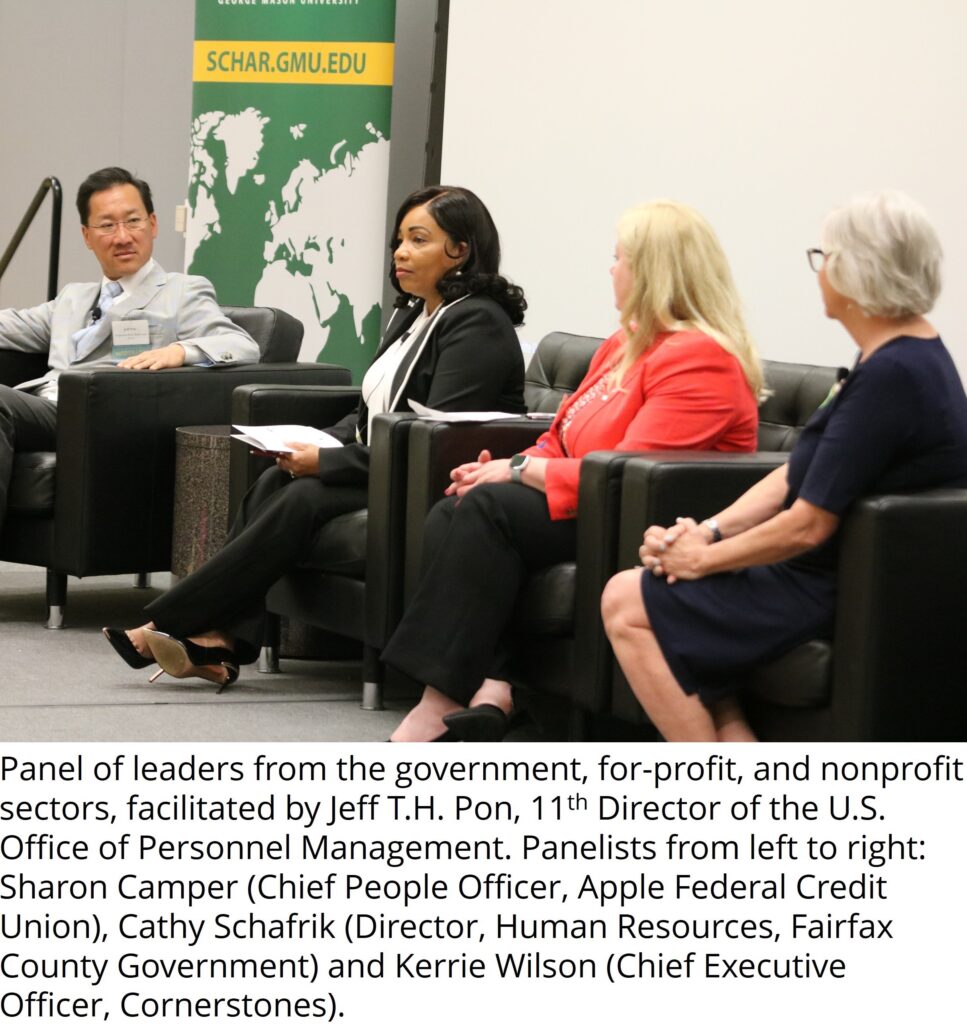
The forum continued with a panel of leaders from the government, for-profit, and nonprofit sectors. Jeff T.H. Pon, 11th Director of the U.S. Office of Personnel Management, facilitated the discussion. He asked panelists about the approaches they used to build and maintain workplace culture as the COVID-19 pandemic changed the nature of work. As Sharon Camper (Chief People Officer, Apple Federal Credit Union), Kerrie Wilson (Chief Executive Officer, Cornerstones), and Cathy Schafrik (Director, Human Resources, Fairfax County Government) spoke about their experiences, it became clear that what works for one organization may not work for others. Yet, a common thread across sectors was the importance of listening to the needs of employees and meaningfully connecting the day-to-day work of employees to the mission or impact of the organization. Examples of specific strategies the panelists used in their organizations included: providing additional compensation to workers whose job requires in-person work; making sure technology is not an additional stressor but helpful; and investing time and resources in activities that employees enjoy and will provide opportunities for connection. The bottom line is that building culture takes intentionality, but having an energized, committed workforce makes culture-building worth the investment. 

The closing keynote was presented by Olivia (Mandy) O’Neill, Associate Professor of Management in the School of Business at George Mason University. She focused on how organizations choose and communicate key values. She engaged the audience by showing several graphics about the organizational values of different companies and asked members of the forum audience how many of the same values (e.g., commitment, excellence, customer-focused, respect) appear in culture statements where they work. A count of raised hands indicated that many organizations, across sectors and with a broad range of goals, tend to use a limited set of terms to describe their culture. She then made the case that not all organizations can be all things, and by not being more strategic and focused in their choice of values, organizations make culture goals easy to ignore. O’Neill suggested that organizations should move to a greater focus on emotional culture, and urged leaders to take stock of how their employees feel and how the leaders want them to feel at work. For example, she explained that many people describe feeling stressed or anxious at work, and that it would help organizations to consider ways to help employees feel appreciated or experience awe. She concluded with several suggestions:

  • Understand how employees view the strengths and weaknesses of their workplace and choose leaders who will cultivate cultures that build on strengths and will engage employees to collaborate in tackling weaknesses.
  • Beware of unintentional consequences. High engagement and strong work relationships can be great for workplace culture but may also lead to burnout and inability to disconnect. Leaders should be aware of these possibilities and take steps to avoid them.
  • Take stock of observable and unobservable indicators of culture, from facial expressions and jargon to the beliefs and assumptions held by employees about their work. These indicators can help leaders assess their organizational culture and lead to adjustments that build stronger workplaces.

In addition to the formal presentations, leaders from across the region had opportunities during the forum to network and deepen cross-sector relationships. Participants were also able to engage with sponsors and learn more about their work.

The Center on Nonprofits, Philanthropy, and Social Enterprise thanks all those who made this event possible, especially our co-hosts and sponsors!

Forum Hosts:

Forum Sponsors: